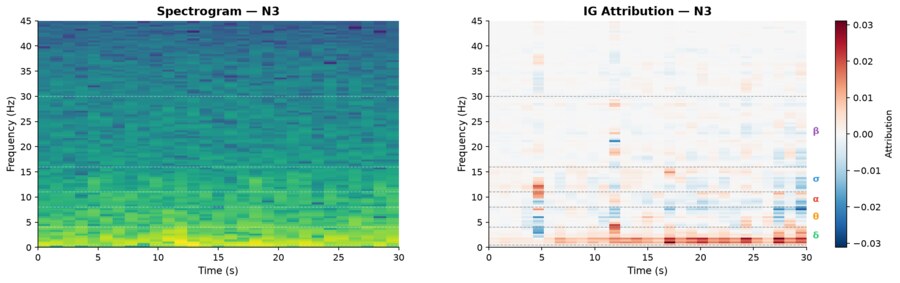
@unpublished{gagliardi2026spectral,author={Gagliardi, Guido and Alfeo, Antonio Luca and Cimino, Mario G. C. A. and Samek, Wojciech and De~Vos, Maarten},title={Spectral Gradients: Disentangled Time--Frequency Attributions to Explain Neural Networks for Time Series},note={Submitted to Pattern Recognition. The PDF is the submitted manuscript; the benchmark code and the per-sample results are archived on Zenodo},doi={10.5281/zenodo.22964216},url={https://doi.org/10.5281/zenodo.22964216},year={2026},}
Preprint v3
Prototype-based interpretable sleep staging with physiologically plausible sub-stage pattern discovery
Guido Gagliardi, Javier Garcia Ciudad, Letizia Micca, Birgitte Rahbek Kornum, Moran Gilat, Antonio Luca Alfeo, Mario G. C. A. Cimino, and Maarten De Vos
2026
Revised manuscript (v3) resubmitted to npj Digital Medicine after minor revision. The PDF is the resubmitted manuscript; version 1, posted on Research Square on 1 April 2026 under an earlier title, is available through the DOI
@unpublished{gagliardi2026prototype,author={Gagliardi, Guido and Garcia Ciudad, Javier and Micca, Letizia and Kornum, Birgitte Rahbek and Gilat, Moran and Alfeo, Antonio Luca and Cimino, Mario G. C. A. and De~Vos, Maarten},title={Prototype-based interpretable sleep staging with physiologically plausible sub-stage pattern discovery},note={Revised manuscript (v3) resubmitted to npj Digital Medicine after minor revision. The PDF is the resubmitted manuscript; version 1, posted on Research Square on 1 April 2026 under an earlier title, is available through the DOI},doi={10.21203/rs.3.rs-9169987/v1},url={https://doi.org/10.21203/rs.3.rs-9169987/v1},year={2026},}
Journal Articles
ML: Health
A multi-source domain fine-tuning framework for deep generalization performance in physiological time series analysis
Eran Zvuloni, Guido Gagliardi, Antônio H. Ribeiro, Antônio Luiz P. Ribeiro, Maarten De Vos, and Joachim A. Behar
@article{zvuloni2026multisource,author={Zvuloni, Eran and Gagliardi, Guido and Ribeiro, Ant\onio H. and Ribeiro, Ant\onio Luiz P. and De~Vos, Maarten and Behar, Joachim A.},title={A multi-source domain fine-tuning framework for deep generalization performance in physiological time series analysis},journal={Machine Learning: Health},volume={2},number={1},pages={015002},year={2026},doi={10.1088/3049-477X/ae2ac5},}
Mach. Learn.
Model-driven validation of visual explanations for multimodal emotion recognition
Guido Gagliardi, Antonio Luca Alfeo, Vincenzo Catrambone, Mario G. C. A. Cimino, Maarten De Vos, and Gaetano Valenza
@article{gagliardi2025model,author={Gagliardi, Guido and Alfeo, Antonio Luca and Catrambone, Vincenzo and Cimino, Mario G. C. A. and De~Vos, Maarten and Valenza, Gaetano},title={Model-driven validation of visual explanations for multimodal emotion recognition},journal={Machine Learning},volume={114},number={12},pages={273},year={2025},doi={10.1007/s10994-025-06921-y},}
Mach. Learn.
Region-aware Minimal Counterfactual Rules for Model-agnostic Explainable Classification
Guido Gagliardi, Antonio Luca Alfeo, Riccardo Guidotti, and Mario G. C. A. Cimino
@article{gagliardi2025region,author={Gagliardi, Guido and Alfeo, Antonio Luca and Guidotti, Riccardo and Cimino, Mario G. C. A.},title={Region-aware Minimal Counterfactual Rules for Model-agnostic Explainable Classification},journal={Machine Learning},volume={114},number={10},pages={225},year={2025},doi={10.1007/s10994-025-06847-5},}
Physiol. Meas.
PhysioEx: a new Python library for explainable sleep staging through deep learning
Guido Gagliardi, Antonio Luca Alfeo, Mario G. C. A. Cimino, Gaetano Valenza, and Maarten De Vos
@article{gagliardi2025physioex,author={Gagliardi, Guido and Alfeo, Antonio Luca and Cimino, Mario G. C. A. and Valenza, Gaetano and De~Vos, Maarten},title={{PhysioEx}: a new {Python} library for explainable sleep staging through deep learning},journal={Physiological Measurement},volume={46},number={2},pages={025006},year={2025},doi={10.1088/1361-6579/adaf73},}
SN Comput. Sci.
Recognizing bearings’ degradation stage using multimodal autoencoder to learn features from different time series
Antonio Luca Alfeo, Mario G. C. A. Cimino, and Guido Gagliardi
@article{alfeo2024recognizing,author={Alfeo, Antonio Luca and Cimino, Mario G. C. A. and Gagliardi, Guido},title={Recognizing bearings' degradation stage using multimodal autoencoder to learn features from different time series},journal={SN Computer Science},volume={5},number={4},pages={371},year={2024},doi={10.1007/s42979-024-02635-5},}
Granul. Comput.
Concept-wise granular computing for explainable artificial intelligence
Antonio Luca Alfeo, Mario G. C. A. Cimino, and Guido Gagliardi
@article{alfeo2023concept,author={Alfeo, Antonio Luca and Cimino, Mario G. C. A. and Gagliardi, Guido},title={Concept-wise granular computing for explainable artificial intelligence},journal={Granular Computing},volume={8},number={4},pages={827--838},year={2023},doi={10.1007/s41066-022-00357-8},}
IEEE Access
Improving emotion recognition systems by exploiting the spatial information of EEG sensors
Guido Gagliardi, Antonio Luca Alfeo, Vincenzo Catrambone, Diego Candia-Rivera, Mario G. C. A. Cimino, and Gaetano Valenza
@article{gagliardi2023improving,author={Gagliardi, Guido and Alfeo, Antonio Luca and Catrambone, Vincenzo and Candia-Rivera, Diego and Cimino, Mario G. C. A. and Valenza, Gaetano},title={Improving emotion recognition systems by exploiting the spatial information of {EEG} sensors},journal={IEEE Access},volume={11},pages={39544--39554},year={2023},doi={10.1109/ACCESS.2023.3268233},}
Peer-Reviewed Conference Papers
NeurIPS
NeuroAtlas: Benchmarking Foundation Models for Clinical EEG and Brain–Computer Interfaces
Konstantinos Kontras, Trui Osselaer, Stylianos G. Mouslech, Angeliki-Ilektra Karaiskou, Guido Gagliardi, Thomas Strypsteen, Mohammad Hossein Badiei, Anku Rani, Maarten Vanmarcke, Miguel Bhagubai, Chanakya Ekbote, Jaedong Hwang, Christos Chatzichristos, Paul Pu Liang, and Maarten De Vos
In Advances in Neural Information Processing Systems 39 (NeurIPS 2026), Datasets and Benchmarks Track, 2026
@inproceedings{kontras2026neuroatlas,author={Kontras, Konstantinos and Osselaer, Trui and Mouslech, Stylianos G. and Karaiskou, Angeliki-Ilektra and Gagliardi, Guido and Strypsteen, Thomas and Badiei, Mohammad Hossein and Rani, Anku and Vanmarcke, Maarten and Bhagubai, Miguel and Ekbote, Chanakya and Hwang, Jaedong and Chatzichristos, Christos and Liang, Paul Pu and De~Vos, Maarten},title={{NeuroAtlas}: Benchmarking Foundation Models for Clinical {EEG} and Brain--Computer Interfaces},booktitle={Advances in Neural Information Processing Systems 39 (NeurIPS 2026), Datasets and Benchmarks Track},url={https://arxiv.org/abs/2605.14698},year={2026},}
IEEE SMC
Building neural networks’ latent space to extract instance-based explanations for sleep staging
Guido Gagliardi, Antonio Luca Alfeo, Mario G. C. A. Cimino, Gaetano Valenza, and Maarten De Vos
In IEEE International Conference on Systems, Man, and Cybernetics (SMC), 2025
@inproceedings{gagliardi2025building,author={Gagliardi, Guido and Alfeo, Antonio Luca and Cimino, Mario G. C. A. and Valenza, Gaetano and De~Vos, Maarten},title={Building neural networks' latent space to extract instance-based explanations for sleep staging},booktitle={IEEE International Conference on Systems, Man, and Cybernetics (SMC)},pages={3096--3101},year={2025},doi={10.1109/SMC58881.2025.11342484},}
ECML PKDD-W
Matching the expert’s knowledge via a counterfactual-based feature importance measure
Antonio Luca Alfeo, Mario G. C. A. Cimino, and Guido Gagliardi
In Machine Learning and Principles and Practice of Knowledge Discovery in Databases — International Workshops of ECML PKDD 2023, Turin, Italy, Revised Selected Papers, Part III, 2025
Workshop paper (post-proceedings), not the ECML PKDD main research track.
@inproceedings{alfeo2023matching,author={Alfeo, Antonio Luca and Cimino, Mario G. C. A. and Gagliardi, Guido},title={Matching the expert's knowledge via a counterfactual-based feature importance measure},booktitle={Machine Learning and Principles and Practice of Knowledge Discovery in Databases --- International Workshops of ECML PKDD 2023, Turin, Italy, Revised Selected Papers, Part III},series={Communications in Computer and Information Science},volume={2135},pages={71--86},publisher={Springer},year={2025},doi={10.1007/978-3-031-74633-8_5},note={Workshop paper (post-proceedings), not the ECML PKDD main research track.},}
IEEE SSCI
Using contrastive learning to inject domain-knowledge into neural networks for recognizing emotions
Guido Gagliardi, Antonio Luca Alfeo, Vincenzo Catrambone, Mario G. C. A. Cimino, Maarten De Vos, and Gaetano Valenza
In IEEE Symposium Series on Computational Intelligence (SSCI), 2023
@inproceedings{gagliardi2023contrastive,author={Gagliardi, Guido and Alfeo, Antonio Luca and Catrambone, Vincenzo and Cimino, Mario G. C. A. and De~Vos, Maarten and Valenza, Gaetano},title={Using contrastive learning to inject domain-knowledge into neural networks for recognizing emotions},booktitle={IEEE Symposium Series on Computational Intelligence (SSCI)},pages={1587--1592},year={2023},doi={10.1109/SSCI52147.2023.10371895},}
IEEE NER
Fine-grained emotion recognition using brain–heart interplay measurements and explainable convolutional neural networks
Guido Gagliardi, Antonio Luca Alfeo, Vincenzo Catrambone, Mario G. C. A. Cimino, Maarten De Vos, and Gaetano Valenza
In 11th International IEEE/EMBS Conference on Neural Engineering (NER), 2023
@inproceedings{gagliardi2023finegrained,author={Gagliardi, Guido and Alfeo, Antonio Luca and Catrambone, Vincenzo and Cimino, Mario G. C. A. and De~Vos, Maarten and Valenza, Gaetano},title={Fine-grained emotion recognition using brain--heart interplay measurements and explainable convolutional neural networks},booktitle={11th International IEEE/EMBS Conference on Neural Engineering (NER)},pages={1--6},year={2023},doi={10.1109/NER52421.2023.10123758},}
IN4PL
Automatic Feature Extraction for Bearings’ Degradation Assessment using Minimally Pre-processed Time Series and Multi-modal Feature Learning
Antonio Luca Alfeo, Mario G. C. A. Cimino, and Guido Gagliardi
In Proceedings of the 3rd International Conference on Innovative Intelligent Industrial Production and Logistics (IN4PL), 2022
@inproceedings{alfeo2022automatic,author={Alfeo, Antonio Luca and Cimino, Mario G. C. A. and Gagliardi, Guido},title={Automatic Feature Extraction for Bearings' Degradation Assessment using Minimally Pre-processed Time Series and Multi-modal Feature Learning},booktitle={Proceedings of the 3rd International Conference on Innovative Intelligent Industrial Production and Logistics (IN4PL)},pages={94--103},year={2022},doi={10.5220/0011548000003329},}
IJCCI
Improving an Ensemble of Neural Networks via a Novel Multi-class Decomposition Schema
Antonio Luca Alfeo, Mario G. C. A. Cimino, and Guido Gagliardi
In Proceedings of the 14th International Joint Conference on Computational Intelligence (IJCCI), 2022
@inproceedings{alfeo2022improving,author={Alfeo, Antonio Luca and Cimino, Mario G. C. A. and Gagliardi, Guido},title={Improving an Ensemble of Neural Networks via a Novel Multi-class Decomposition Schema},booktitle={Proceedings of the 14th International Joint Conference on Computational Intelligence (IJCCI)},pages={389--395},year={2022},doi={10.5220/0011547900003332},}
Conference Abstracts
ESRS
An explainable artificial intelligence technique to interpret deep learning models aimed at detecting paediatric sleep apnoea from airflow and oximetry signals
Javier Jiménez-García, Julie Michiels, Guido Gagliardi, Gonzalo C. Gutiérrez-Tobal, Miriam García, and others
2024
CASEIB
Inteligencia artificial explicable basada en Shapley values para interpretar modelos de deep learning orientados a detectar la apnea del sueño pediátrica usando flujo aéreo y oximetría
Javier Jiménez García, Gonzalo C. Gutiérrez Tobal, Miriam García Gadañón, Julie Michiels, Guido Gagliardi, David Gozal, Maarten De Vos, and Roberto Hornero
2024
About the PDFs. Copies hosted here are either published under a Creative Commons licence, or author manuscripts already made public through an institutional repository (KU Leuven Lirias, University of Pisa ARPI) or my co-authors’ group pages. The remaining PDF buttons link to the publisher’s, arXiv’s or SciTePress’s own open-access copy. Only the two congress abstracts have no openly available version — for those, use the DOI.
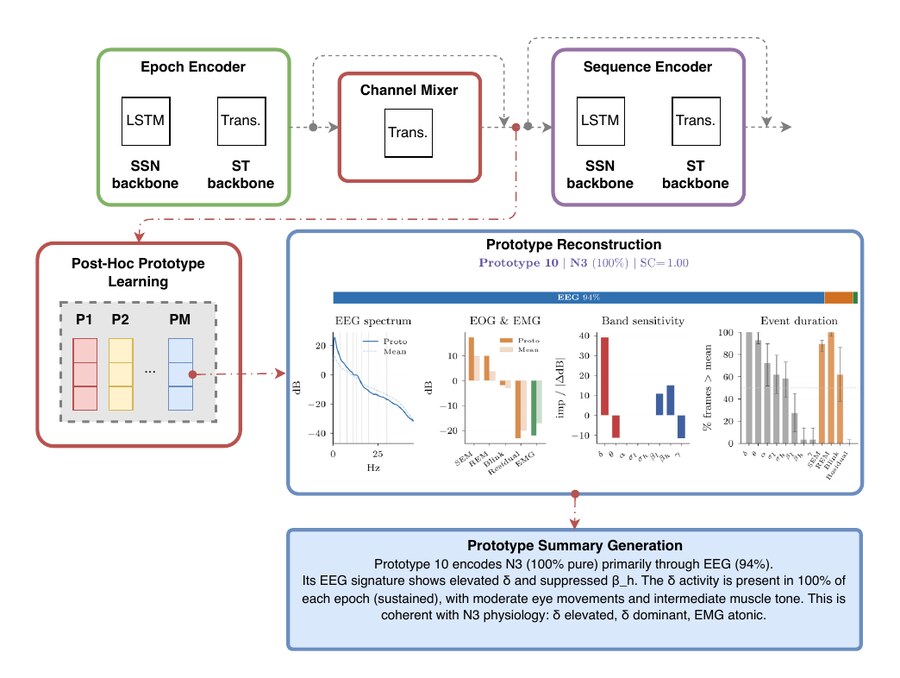 Prototype-based interpretable sleep staging with physiologically plausible sub-stage pattern discovery2026Revised manuscript (v3) resubmitted to npj Digital Medicine after minor revision. The PDF is the resubmitted manuscript; version 1, posted on Research Square on 1 April 2026 under an earlier title, is available through the DOI