research
The programme, and the record behind it.
Research programme
I build deep learning models for clinical neurophysiology that explain their own decisions — so clinicians can audit them, and so their explanations can teach us something new about disease.
The core of this work is a clinical sleep profiling study at UZ Leuven, where we showed that deep learning combined with concept-based explainability can do three things at once: stage sleep in healthy subjects and in patients with Parkinson’s disease and Alzheimer’s dementia, through a pipeline benchmarked against the AASM Manual for the Scoring of Sleep; reveal how sleep macro- and micro-structure change under neurological disease; and turn that newly surfaced knowledge back into a signal for detection and classification. The point is the third step. An explanation that only reassures the clinician is a user-interface feature; an explanation that yields a measurable disease marker is a scientific result.
The same pipeline is now being applied to narcoleptic mouse models with Prof. B. R. Kornum (Department of Neuroscience, University of Copenhagen) and to patients with Alzheimer’s disease and REM Sleep Behaviour Disorder with J. Strøm (Center for Ear-EEG, Aarhus University).
So far this has been physiological signals, but nothing in the methodology is specific to them. My next step is to extend it to other clinical modalities — medical imaging and the electronic health record — and to embed it in agentic decision-support tools for high-stakes settings such as neurocritical care.
Trustworthiness
Measuring model performance beyond task accuracy: explaining the decision-making process, quantifying uncertainty so that a model can abstain when the evidence is weak, and validating its reasoning against established clinical guidelines — so that a clinician can understand, check and trust the system before it enters a diagnostic workflow.
This is the line running from concept-wise granular computing (Alfeo et al., 2023) through instance-based explanations in a learned latent space (Gagliardi et al., 2025) to prototype-based sleep micro-structure learning (Gagliardi et al., 2026), where reading the prototypes is reading the decision. Alongside it sits the counterfactual line — a model-agnostic feature-importance measure matched against expert knowledge (Alfeo et al., 2025) and region-aware minimal counterfactual rules (Gagliardi et al., 2025) — and the question of whether a visual explanation can be validated at all rather than merely inspected (Gagliardi et al., 2025).
Knowledge discovery
Using AI not merely as an automation tool but as a scientific instrument: identifying complex, previously unknown correlations in clinical data, whose explanation can yield new domain knowledge about disease mechanisms.
In practice this means treating the learned representation as an object of study. Which micro-structural patterns does a well-performing sleep model rely on, and do they change with Parkinson’s disease or Alzheimer’s dementia? Injecting domain knowledge into the representation rather than only reading it out is the complementary direction (Gagliardi et al., 2023), as is exploiting the physical layout of the sensors themselves (Gagliardi et al., 2023).
Foundation models and agentic AI
Engineering foundation models for neurophysiological signals with semantic embeddings, and agentic systems that ground large-language-model reasoning in verifiable clinical knowledge through retrieval — turning explainable representations into auditable, clinician-facing decision-support tools.
Benchmarking is the prerequisite, and it is where this line currently sits (Kontras et al., 2026); generalisation across cohorts is the other half of the problem (Zvuloni et al., 2026). The agentic side is deliberately exploratory: retrieval over the AASM manual selecting the rule, a deterministic engine deciding the stage, and a language model writing only the justification — see agentic-aasm-staging.
Supervision and mentoring
Between 2022 and 2026 I supervised 12 M.Sc. theses at the University of Pisa — 10 as principal advisor (relatore), one as co-advisor, one as tutor — together with Prof. M. G. C. A. Cimino and Prof. A. L. Alfeo. Day-to-day supervision was mine: problem definition, method, experiments and writing. Cimino and Alfeo were the formal supervisors.
M. Manni (2024) — Enabling Concept-Embedding Models for Sleep Staging through Automatic Prototype-Based Learning of Concepts. The automatic prototype-discovery mechanism developed here became a component of ProtoSleepNet.
C. Daka (2025) — Extracting Region-Aware Counterfactual Rules for Model-Agnostic Explainable Artificial Intelligence. The same research line as our 2025 Machine Learning paper on region-aware counterfactual rules. Now a PhD student at the University of Pisa, continuing on explainable AI architectures.
I. Grillo (2026) — Design and Development of a Transformer-Based Model for Subject-Invariant R-Peak Localization in EEG Signals. Now a PhD student at KU Leuven, working on explainable AI for brain foundation models.
Two of these students went on to doctoral study, one of them in my own department.
Full list of supervised theses (12)
Titles as deposited in the University of Pisa ETD archive.
| Defended | Role | Student | Deposited title |
|---|---|---|---|
| 23/09/2022 | advisor | F. Ritorti | Distance-based representation learning for recognizing emotions via EEG data |
| 18/11/2022 | advisor | N. Mota | Concept-wise architecture with topology learning for explainable emotion classification |
| 18/11/2022 | advisor | M. Martorana | A novel feature importance measure to explain the quality level prediction in Smart Manufacturing |
| 28/04/2023 | tutor | F. Marabotto | Explainable emotion recognition via a novel loss function based on informed contrastive learning |
| 16/06/2023 | advisor | G. Cancello Tortora | Analyzing brain data for robust emotion recognition via conceptual decomposition based on autoencoders |
| 16/06/2023 | advisor | L. Turchetti | Sleep stage recognition supported by instances-based explanation via contrastive learning |
| 22/09/2023 | advisor | T. Nocchi | Design and Experimental Evaluation of a Novel Model-Agnostic Feature Importance Measure for Quality Measures in Industrial Production Processes |
| 26/11/2024 | advisor | M. Manni | Enabling Concept-Embedding Models for Sleep Staging through Automatic Prototype-Based Learning of Concepts |
| 21/02/2025 | advisor | — | Analysis of a counterfactual-based feature importance measure: fidelity, computational cost and influencing factors |
| 21/02/2025 | co-advisor | E. Tinghi | A double quantization approach for autonomous concept learning in sleep staging |
| 02/10/2025 | advisor | C. Daka | Extracting Region-Aware Counterfactual Rules for Model-Agnostic Explainable Artificial Intelligence |
| 2026 | advisor | I. Grillo | Design and Development of a Transformer-Based Model for Subject-Invariant R-Peak Localization in EEG Signals |
Funding
I have secured approximately €200,000 in competitive personal funding, plus compute allocations on three national and European supercomputers.
- FWO Strategic Basic Research Fellowship (mandate 1SH4Z24N), ~€131,000, 2023– — success rate below 20%.
- FWO Travel Grant, Long Research Stay Abroad (mandate V458425N), €9,900, 2025 — funded the research stay at Fraunhofer HHI.
- Pegaso Scholarship, Regione Toscana (Giovanisì), €61,300, 2021–2023.
- Compute: VSC (Flanders), LUMI (EuroHPC JU) and Leonardo/CINECA — all competitively allocated.
Teaching and service
- Guest Lecturer, Explainable & Trustworthy Artificial Intelligence, Ghent University (UGain / VAIA professional course), 2026. Course coordinated by Prof. Dr. Femke De Backere.
- Teaching Assistant, Biomedical Signal Processing, KU Leuven, 2021–2026 — M.Sc. programmes in Biomedical Engineering and Electrical Engineering.
- Submission Chair, IEEE ICAI-TEMS 2026, Pisa.
- Reviewer for AAAI 2026 and Journal of Ambient Intelligence and Humanized Computing.
- Member of the Sleep Revolution network (Horizon 2020, grant agreement 965417).
Collaborations
This work is done with Prof. W. Samek (Fraunhofer HHI Berlin) on attribution methods, Prof. J. A. Behar (Technion) and Prof. A. L. P. Ribeiro (Universidade Federal de Minas Gerais) on cross-cohort generalisation in physiological time series, Prof. B. R. Kornum (University of Copenhagen) on narcolepsy models, Dr. J. Jiménez-García (University of Valladolid) on paediatric sleep apnoea, and J. Strøm (Center for Ear-EEG, Aarhus University) on Alzheimer’s disease and REM Sleep Behaviour Disorder.
- Preprint v3
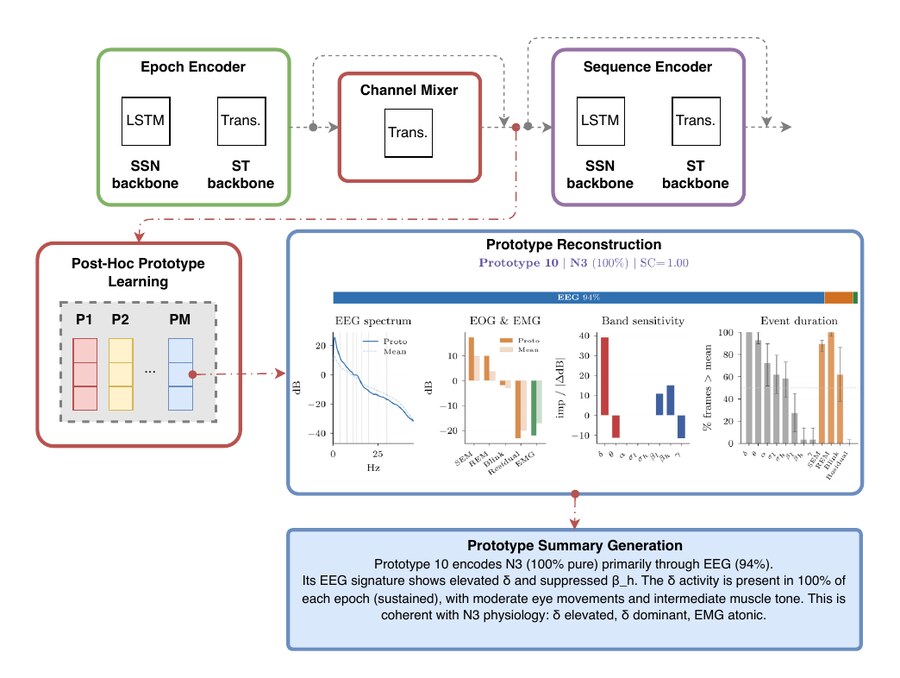 Prototype-based interpretable sleep staging with physiologically plausible sub-stage pattern discovery2026Revised manuscript (v3) resubmitted to npj Digital Medicine after minor revision. The PDF is the resubmitted manuscript; version 1, posted on Research Square on 1 April 2026 under an earlier title, is available through the DOI
 - ECML PKDD-WMatching the expert’s knowledge via a counterfactual-based feature importance measureIn Machine Learning and Principles and Practice of Knowledge Discovery in Databases — International Workshops of ECML PKDD 2023, Turin, Italy, Revised Selected Papers, Part III, 2025Workshop paper (post-proceedings), not the ECML PKDD main research track.