Guido Gagliardi
Post-Doctoral Researcher · STADIUS, ESAT, KU Leuven

ESAT–STADIUS, KU Leuven
Kasteelpark Arenberg 10
3001 Leuven, Belgium
I build deep learning models for clinical neurophysiology that explain their own decisions — so clinicians can audit them, and so their explanations can teach us something new about disease.
I am a post-doctoral researcher at STADIUS, KU Leuven, in the group of Prof. Maarten De Vos, where I work on explainable deep learning for physiological signals. I hold a dual PhD with honors from KU Leuven and the Italian universities of Florence, Siena and Pisa, defended in May 2026. Before starting the postdoc I spent six months at Fraunhofer HHI in Berlin with Prof. Wojciech Samek’s AI department, working on attribution methods for time–frequency data.
My work is built around a single question: when a model reads a clinical signal well, what does it know that we do not? I develop methods that make that knowledge legible — prototypes, concept-based explanations, spectral attributions — and validate them against clinical guidelines and against disease. Most of it ships as open-source software: PhysioEx and ProtoSleepNet are the libraries my papers are built on, and they are what anyone else needs to reproduce or extend the results.
Research directions
Trustworthiness. Measuring performance beyond task accuracy: explaining the decision process, quantifying uncertainty so a model can abstain when the evidence is weak, and validating against clinical guidelines such as the AASM scoring manual.
→ Read more
Knowledge discovery. Using AI not as an automation tool but as a scientific instrument — finding correlations in clinical data that were not known beforehand, and turning their explanation into domain knowledge about disease mechanisms.
→ Read more
Foundation models and agentic AI. Engineering foundation models for neurophysiological signals with semantic embeddings, and agentic systems that ground language-model reasoning in verifiable clinical knowledge through retrieval.
→ Read more
Currently
Extending prototype-based sleep analysis to narcoleptic mouse models with Prof. B. R. Kornum (University of Copenhagen), and to Alzheimer’s disease and REM Sleep Behaviour Disorder with the Center for Ear-EEG (Aarhus University). Spectral Gradients, on disentangled time–frequency attributions, is under review at Pattern Recognition with Prof. W. Samek.
I am looking for tenure-track and junior-professor positions in Europe starting 2027.
news
| Oct 26, 2026 | ProtoSleepNet has been accepted for publication in npj Digital Medicine. Until the published version is out, the accepted manuscript, the code release and the live demo are available. |
|---|---|
| Oct 10, 2026 | ProtoSleepNet: the revised manuscript (v3) has been resubmitted to npj Digital Medicine in response to the minor revision. The manuscript, the code release matching it (PhysioEx 2.0.2) and the live demo are public. |
| Sep 29, 2026 | NeuroAtlas has been accepted at NeurIPS 2026, Datasets and Benchmarks track. Paper · arXiv |
| Sep 27, 2026 | Spectral Gradients, on disentangled time–frequency attributions for time-series models, is submitted to Pattern Recognition. The preprint, the benchmark code and the per-sample results (Zenodo) are public. |
selected publications
- npj Digit. Med.
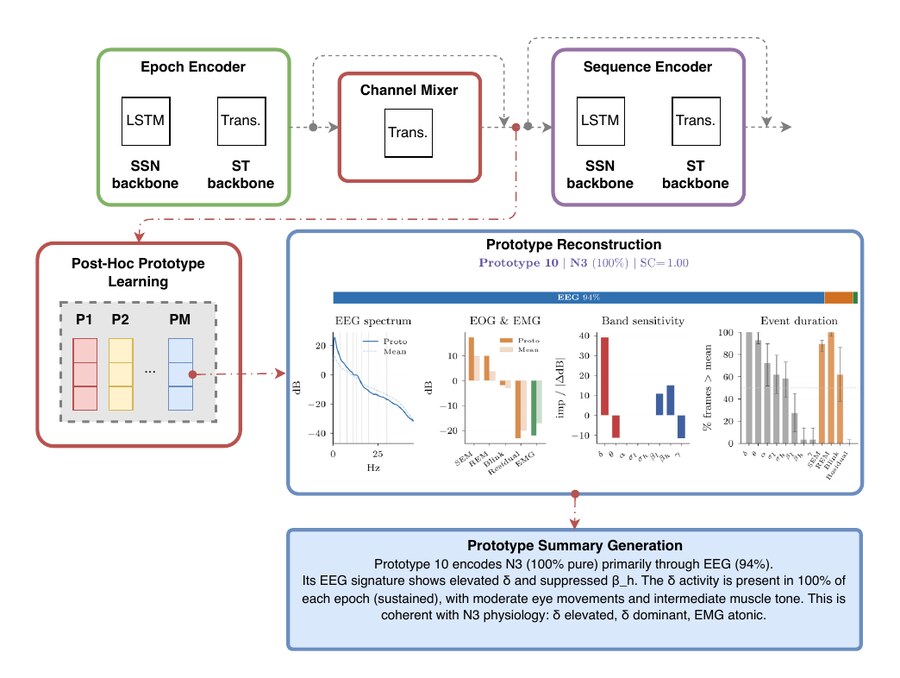 Prototype-based interpretable sleep staging with physiologically plausible sub-stage pattern discovery2026Accepted for publication in npj Digital Medicine. The PDF is the accepted manuscript (v3); version 1, posted on Research Square on 1 April 2026 under an earlier title, is available through the DOI