ProtoSleepNet#
Prototype-based, interpretable sleep staging — where reading the prototypes is reading the decision.





Code for “Prototype-based interpretable sleep staging with physiologically plausible sub-stage pattern discovery” (ProtoSleepNet), under review at npj Digital Medicine. The revised manuscript is on the project website; version 1 is on Research Square, 10.21203/rs.3.rs-9169987/v1, under an earlier title.
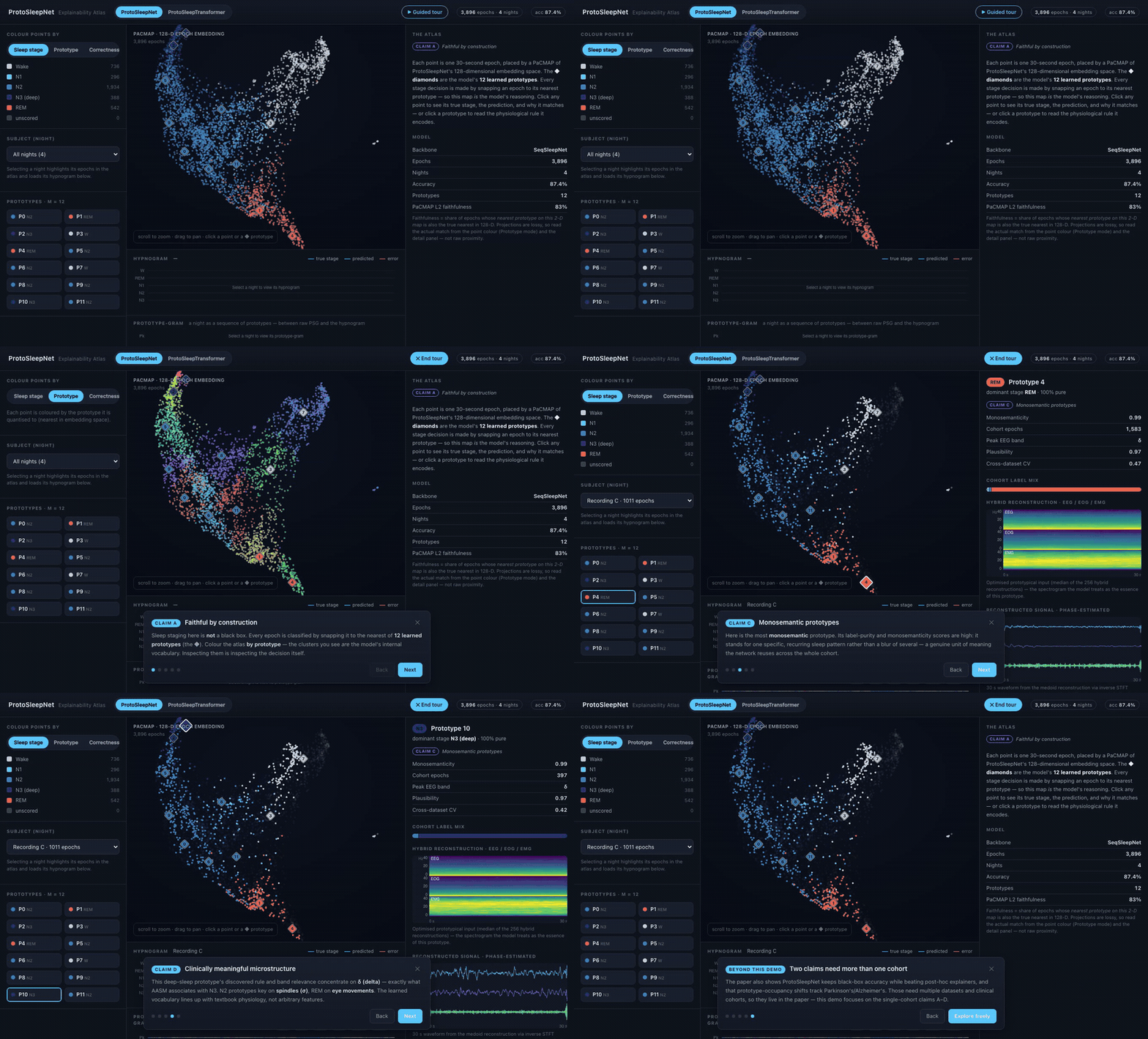
▶ Try it live — protosleepnet-demo.pages.dev — an interactive atlas of the prototype space: click any epoch to see the exact evidence for its stage.
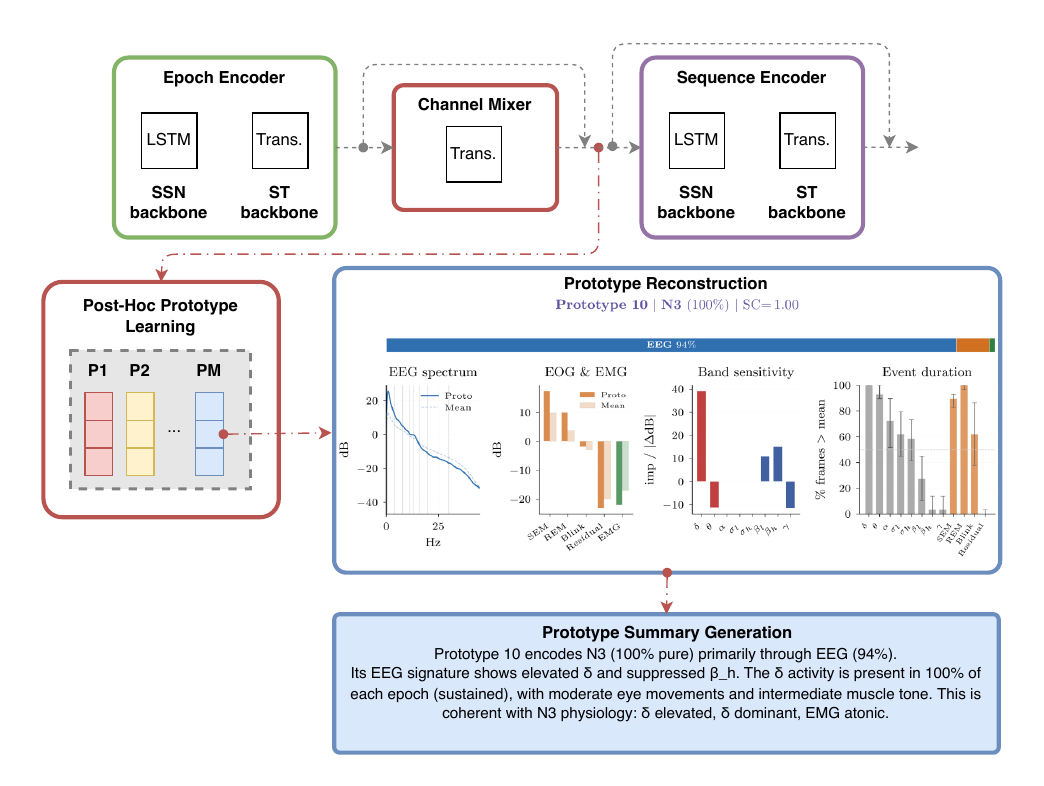
ProtoSleepNet wraps a sleep-staging backbone (SeqSleepNet or SleepTransformer) with a Prototype Sub-Stage (PSS) module: per-channel encoding, modality embeddings, accuracy-weighted modality dropout, a Transformer channel mixer and a dual-residual path, yielding contextualized epoch embeddings that are quantized into a small, interpretable prototype codebook. The prototypes carry physiologically plausible, AASM-coherent sub-stage patterns and support exploratory clinical probing (Alzheimer’s, Parkinson’s).
📖 Documentation: guidogagl.github.io/protosleepnet — method overview, a guide to how to interpret the model, the embedded live demo, and the full paper-reproduction recipe.
Built on physioex v2.0.2.
The model architecture, data loaders, preprocessing, dataset splits, seeds and evaluation metrics all live in
physioex. This repository holds only the experiment pipeline that produced every figure and table in the paper and its Supplementary Notes.

Installation#
conda env create -f environment.yml && conda activate protosleepnet   # optional
pip install -e .                     # installs the `protosleepnet` package + physioex==2.0.2
pip install -e ".[events]"           # + YASA/pyedflib, only for the detected-events analysis
Requires Python ≥ 3.10. After pip install -e . every script runs as a module
from the repo root — one convention throughout:
python -m protosleepnet.train --help
python -m protosleepnet.figure_reconstruction.spectral_signature --help
Pretrained weights#
Weights are on the HuggingFace Hub and load through physioex. Names follow the
physioex convention <model>-<primary-author>. The paper’s models live in
4rooms/sleep-prototypes
(the Phan originals {seqsleepnet,sleeptransformer}-phan are in 4rooms/physioex):
from physioex.models import load_from_pretrained
# PST — SleepTransformer backbone (SHHS, L=21)
model = load_from_pretrained("protosleeptransformer-gagliardi", repo_id="4rooms/sleep-prototypes")
# PSN — SeqSleepNet backbone (MASS, L=20)
# load_from_pretrained("protosleepnet-gagliardi", repo_id="4rooms/sleep-prototypes")
# input  (batch, L, 3, 29, 129) STFT log-power (EEG/EOG/EMG); output (batch, L, 5) AASM logits
The 3-channel baselines and ablation variants are published alongside them:
{seqsleepnet,sleeptransformer}-gagliardi[-dropout|-mixer].
bash reproduce.sh runs a smoke path (load weights → forward pass → regenerate one figure).
Data#
11 PSG datasets / 20 dataset-sources (12,317 subjects). Raw recordings are not
redistributed here — obtain them from the sources below and preprocess them with
physioex (this repo depends on physioex’s preprocessing; it ships none of its own).
See the physioex docs and the launchers in examples/slurm/.
Datasets |
Access |
|---|---|
SHHS, MrOS, MESA, WSC, HomePAP |
NSRR — controlled/registered (https://sleepdata.org) |
HMC, Sleep-EDF |
PhysioNet — open |
MASS, DCSM |
open on request |
ASD (Alzheimer), KPD (Parkinson) |
KU Leuven — restricted (contact authors; ethics S61792/S70708) |
Configuration (environment variables)#
Scripts read paths from the environment so no absolute paths are baked in:
Variable |
Meaning |
Default |
|---|---|---|
|
physioex dataset root (preprocessed datasets; raw MASS SS2 EDFs for the detected-events analysis) |
— |
|
root for predictions, embeddings and reconstruction outputs |
|
|
checkpoints / training statistics |
|
|
per-prototype reconstruction records (Fig 3–4, Tab 1–2 sources) |
|
|
root of the analysis modules ( |
|
|
raw KPD recordings (lights-off markers; clinical probing only) |
— |
Cluster launchers additionally source examples/slurm/env.sh (copy from
examples/slurm/env.sh.example).
Repository layout#
src/protosleepnet/            # installable package (run as python -m protosleepnet.<mod>)
  train.py  test_pretrained.py  extract_embeddings.py   # staging training / evaluation
  learn_prototypes_vq.py  test_prototypes.py            # VQ codebook learning + quantized inference
  test_occlusion.py  test_prototype_randomization.py    # occlusion robustness, prototype randomization
  seed_*.py  convert_and_predict_seeds.py              # seed-stability pipeline
  build_protosleepnet.py                                # shared model factory
  ablation/  baselines/                                 # component ablation; residual / mixer / dropout variants
  posthoc_prototypes/                                   # k-means codebooks, quantization disagreement, codebook refinement
  proto_reconstruction/                                 # data-driven / model-driven / hybrid reconstruction
  figure_reconstruction/                                # rules, spectral & relevance signatures, local IG,
                                                        #   threshold sweeps, stage permutation, detected events
  clinical_probing/                                     # atlas, per-subject records, 20 features, nested LOSO,
                                                        #   hypnogram comparator, DeLong inference, deficit structure
  plot/                                                 # portable figure scripts (from predictions)
  demo/                                                 # interactive-demo precompute pipeline + static app
examples/slurm/    # cluster launchers; copy env.sh.example -> env.sh (analysis/ = CPU-only analyses)
data/              # small committed figure-source JSON only (see below)
scripts/           # HuggingFace upload of the released weights + model cards
tests/             # smoke tests (import graph + optional pretrained forward pass)
Large artifacts (predictions, embeddings, reconstruction arrays, checkpoints) are
not in git. Only small figure-source JSON is committed under data/:
data/reconstructions/M12/ (per-prototype records behind Fig 3–4 and Tab 1–2,
also the input of the demo and of the checklist analyses) and
data/probing_staging_summary/ (staging tables of Supplementary Note 1).
Reproducing the paper (Figure/Table → experiment → command)#
Each command below is the entry point; pass --help for its options. Full
experiment settings (M value, seeds, datasets) are documented per script.
Modules under clinical_probing/ run in the order listed.
Paper asset |
Experiment |
Command |
|---|---|---|
Fig 2a; Supp Note 1 |
In-domain + OOD staging, per-class, confusion, stats |
|
Supp Note 2 |
Component ablation (4 variants) + occlusion robustness |
|
Fig 2b; Supp Note 3 |
M-sweep, VQ methods, residual baselines |
|
Supp Note 3 (§5) |
Continuous-vs-quantized disagreement; paired per-subject κ |
|
Fig 4; Supp Notes 5, 6 |
Prototype reconstruction (data/model/hybrid) + cross-dataset |
|
Fig 3; Tab 1, 2; Supp Notes 4, 6 |
Codebook summaries, band-ablation rules, coherence checklist, local IG |
|
Tab 2; Supp Note 6 (§5) |
Checklist threshold sweeps + joint margins; stage-permutation control |
|
Supp Note 6 (§10) |
Automatically detected spindles / slow waves vs band relevance (MASS SS2; needs |
|
Supp Note 8 |
Prototype randomization |
|
Supp Note 9 |
Seed stability (training seeds, reconstruction, MMD) |
|
Supp Note 9 (§4) |
Coarse-to-fine codebook refinement across adjacent M |
|
Fig 5; Tab 3; Supp Note 7 |
Clinical probing (ASD, KPD): frozen embeddings → training atlas → per-subject records → 20 features → 34-descriptor comparator → nested LOSO → DeLong inference → deficit structure |
|
Live demo |
Subject selection, anonymized subset, PaCMAP atlas, per-epoch IG, prototype cards |
|
CPU-only analyses have ready-made launchers under examples/slurm/analysis/.
Manuscript figure/table assembly (LaTeX-coupled emitters) is kept out of this
repo, with the paper sources.
Tests#
pip install -e . pytest
pytest                 # import-graph smoke test (no network)
pytest --runslow       # also pull weights from HuggingFace and run a forward pass
Citation#
If you use this code, please cite the paper and the software — see CITATION.cff.
This work builds on physioex v2.0.2.
License: MIT (LICENSE).